Young's modulus
Young's modulus
Young's modulus is a mechanical property of solid materials that measures the tensile or compressive stiffness when the force is applied lengthwise, i.e. it quantifies the material's resistance to deformation. It is the modulus of elasticity for tension or axial compression.
Young's modulus, \[E\], quantifies the relationship between tensile or compressive stress and axial strain in the linear elastic region of a material: \[E=\frac{\sigma}{\epsilon}=\frac{\frac{F}{A}}{\frac{\Delta L}{L}}\].
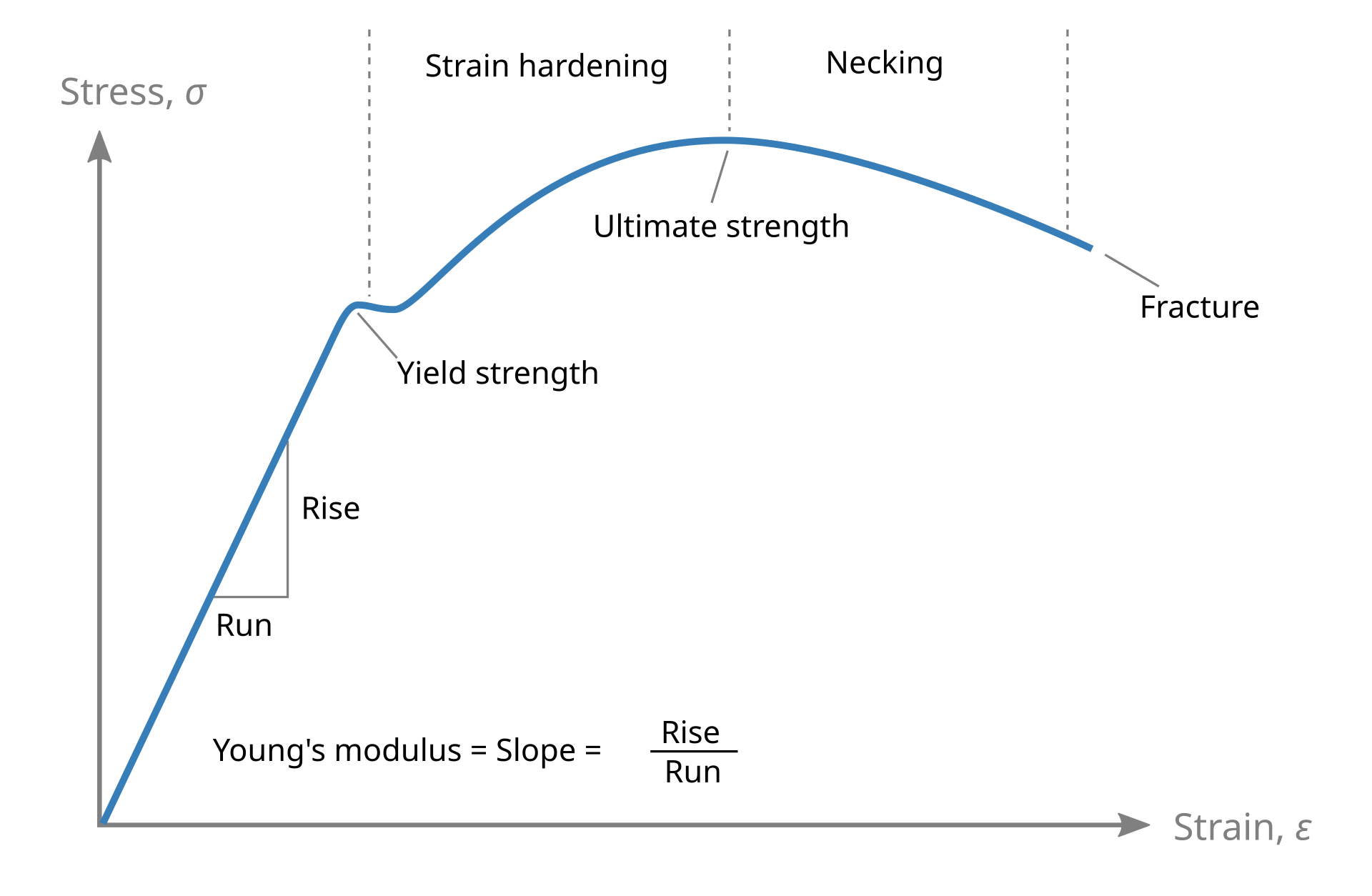
The basic principle is that a material undergoes elastic deformation when it is compressed or extended, returning to its original shape when the load is removed. More deformation occurs in a flexible material compared to that of a stiff material. In other words, a low Young's modulus value means a solid is elastic while a high Young's modulus value means a solid is inelastic or stiff.