bulk stress, strain and modulus
Bulk stress, strain and modulus
When you dive into water, you feel a force pressing on every part of your body from all directions. What you are experiencing then is bulk stress, or in other words, pressure. Bulk stress always tends to decrease the volume enclosed by the surface of a submerged object. The forces of this “squeezing” are always perpendicular to the submerged surface. The effect of these forces is to decrease the volume of the submerged object by an amount \[\Delta V\] compared with the volume \[V_{o}\] of the object in the absence of bulk stress.
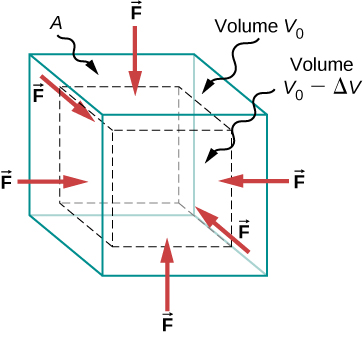
Bulk stress: \[\frac{F_{\perp}}{A}=p\], where \[p\] is pressure. An important characteristic of pressure is that pressure acts equally in all possible directions. When you submerge your hand in water, you sense the same amount of pressure acting on the top surface of your hand as on the bottom surface, or on the side surface, or on the surface of the skin between your fingers. What you are perceiving in this case is an increase in pressure \[\Delta p\] over what you are used to feeling when your hand is not submerged in water. What you feel when your hand is not submerged in the water is the normal pressure \[p_{o}\] of one atmosphere, which serves as a reference point. The bulk stress is this increase in pressure, or \[\Delta p\], over the normal level, \[p_{o}\].
Bulk strain: \[\frac{\Delta V}{V_{o}}\]
Bulk modulus: \[-\frac{\Delta p}{\frac{\Delta V}{V_{o}}}=-\Delta p \frac{V_{o}}{\Delta V}\], note that the negative is necessary because an increase in \[\Delta p\] in pressure always causes a decrease in \[\Delta V\]