bounded function
Bounded function
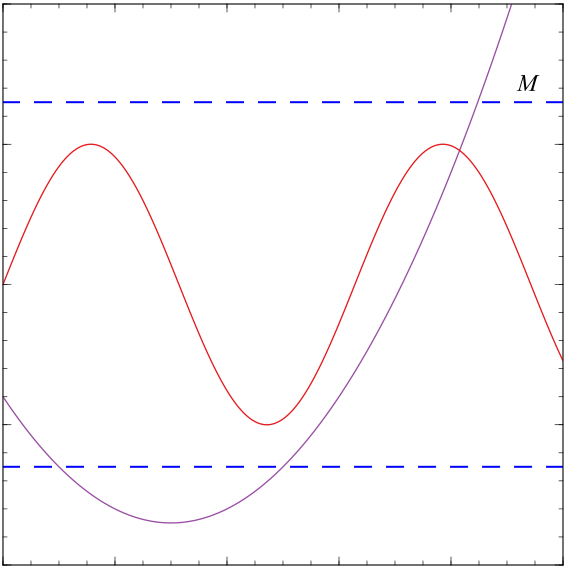
An illustration of a bounded function (red) and an unbounded function (purple).
A function \[f\] defined on some set \[X\] (meaning \[X\] is the domain of \[f\]) is bounded if the set of its values is bounded. In other words, there exists a real number \[M\] such that \[\left| f(x) \right|\le M\] for all \[x\] in \[X\].
If \[f\] is real-valued and \[f(x)\le A\] for all \[x\] in \[X\], then the function is said to be bounded from above by \[A\]. Similarly, if \[f(x)\ge B\] for all \[x\] in \[X\], then the function is said to be bounded from below by \[B\].
Bounded sequence
Let a sequence \[f=\left( a_{0},a_{1},a_{2},\dots \right)\]. This sequence is bounded if and only if ther exists a real number \[M\] such that \[\left| a_{n} \right|\le M\] for \[n\in\mathbb{N}\].