intermolecular force
Intermolecular force
Intermolecular forces (IMF) is the force that mediates interaction between molecules, including the electromagnetic forces of attraction or repulsion which act between atoms and other types of neighbouring particles, e.g. atoms or ions. Intermolecular forces are weak relative to intramolecular forces, the forces which hold a molecule together.
Hydrogen bonding
Dipole-dipole interactions
dipole-dipole & dipole-induced dipole
Known as
- Keesom force, or permanent dipole-permanent-dipole (pd-pd)
- Debye force, or permanent dipole-induced dipole (pd-id)
Ion-dipole interactions
London dispersion forces
London dispersion forces
Known as instantaneous dipole-induced dipole (id-id)
Strength of different forces
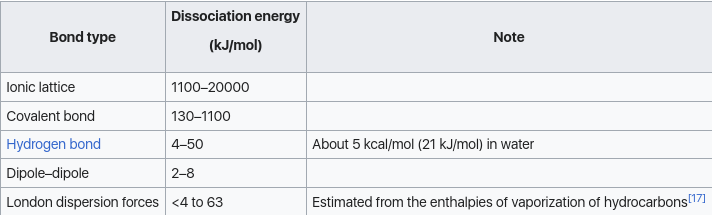
This comparison is approximate. The actual relative strengths will vary depending on the molecules involved. For instance, the presence of water creates competing interactions that greatly weaken the strength of both ionic and hydrogen bonds. We may consider that for static systems, ionic bonding and covalent bonding will always be stronger than intermolecular forces in any given substance.