transpose (matrix)
Transpose
The transpose of a matrix is an operator which flips a matrix over its diagonal, e.g. let \[A=\begin{pmatrix} 1&2\\3&4\\5&6 \end{pmatrix}\], then \[A^{T}=\begin{pmatrix} 1&3&5\\2&4&6 \end{pmatrix}\]. Formally, it's definition is that the \[i\]-th row, \[j\]-th column element of \[A^{T}\] is the \[j\]-th row, \[i\]-th column element of \[A\], i.e. \[(A^{T})_{ij}=A_{ji}\].
Properties
Define \[A\] and \[B\] as matrices and \[c\] a scalar.
- \[\left( A^{T} \right)^{T}=A\]
- \[(A+B)^{T}=A^{T}+B^{T}\]
- \[(cA)^{T}=c(A^{T})\]
- \[(AB)^{T}=B^{T}A^{T}\]
- \[\det(A^{T})=\det(A)\]
Proof for \[(AB)^{T}=B^{T}A^{T}\]
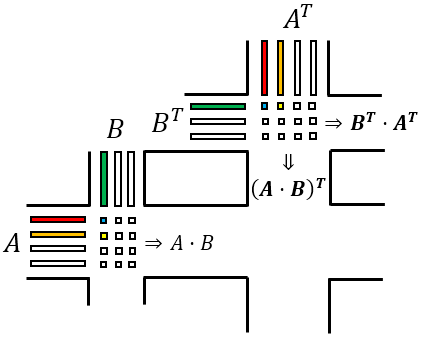
Based on our definition, we know that \[(AB)^{T}_{ij}=(AB)_{ji}\], then based on the definition for matrix multiplication, \[(AB)_{ji}=\sum_{k=1}^{n}(A_{jk}\cdot B_{ki})\].
On the other hand, \[(B^{T}A^{T})_{ij}=\sum_{k=1}^{n}(B_{ik}^{T}\cdot A_{kj}^{T})=\sum_{k=1}^{n}(B_{ki}\cdot A_{jk})=\sum_{k=1}^{n}(A_{jk}\cdot B_{ki})\]. Therefore, \[(AB)^{T}_{ij}=(AB)_{ji}=(B^{T}A^{T})_{ij}\], which implies that \[(AB)^{T}=B^{T}A^{T}\].