reference angle (trigonometry)
Reference angle
In a right triangle, the angles are restricted to 90 degrees and below, so we use trigonometric ratios for acute angles. However, with the unit circle, we can now define sine, cosine, and tangent for any angle, e.g. 237 degrees, which would not appear in a triangle. Even though 237 degrees can never be an angle in a triangle, it still corresponds to a specific point on the unit circle.
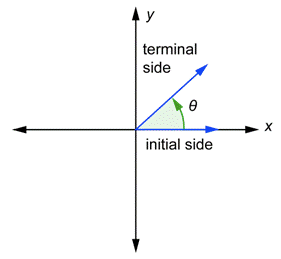
This brings us to angles of standard position. We call it an angle of standard position when the angle is between two sides, where the initial side and is always placed on the positive \[x\]-axis, while the other side, called the terminal side, points to anywhere on the unit circle, forming angles such as 173 degrees and -38 degrees.
As a side note, negative angles are just a matter of convention, which notes that the direction of the angle is clockwise.
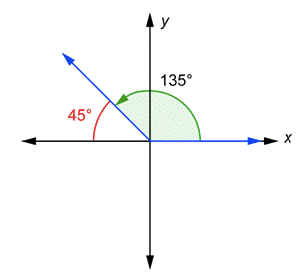
We also know that for each angle drawn in standard position, there must be a related angle known as the reference angle formed by the terminal side and the \[x\]-axis which naturally has a value restricted to only \[0^{\circ}\le\theta\le90^{\circ}\].
The reference angle is simply a definition that is introduced to simplify the analysis of trigonometric functions for any angle by allowing us to relate any angle back to an acute angle.
The reason why we claim that that there must exist a reference angle for every angle in standard position is that trigonometric functions are periodic and symmetric. Take a cosine wave for example,
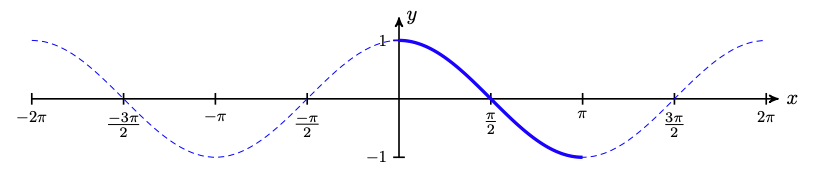
We can see that the amplitude of the wave at 115 degrees is the same as when it's at 65 degrees, albeit negative. In a right-angled triangle with a hypotenuse of length one, \[\cos\theta\] represents the length of the side adjacent to the angle. With this we can deduce that 115 degrees has a reference angle of 65 degrees and lies in the second quadrant where cosine values are negative. Thus, we can conclude that \[-\cos115^{\circ}=\cos65^{\circ}\].
Uses
Reference angles are useful in scenarios such as calculating forces of different directions, e.g. finding the resultant force of a few different forces going in different directions such as 30 degrees, 50 degrees, 210 degrees and 300 degrees, allowing us to find the vertical and horizontal components of these forces with direction included.