trigonometric identities
Trigonometric identities
Pythagorean identities
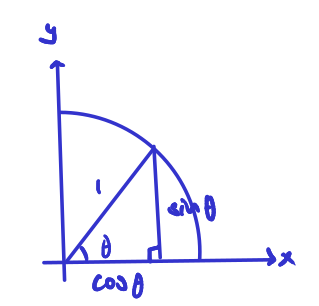
The above is a unit circle, which has a radius of 1. Since it's a right-angled triangle, \[(\sin\theta)^{2}+(\cos\theta)^{2}=\sin^{2}\theta+\cos^{2}\theta=1^{2}\].
- \[\sin\theta=\frac{1}{\csc\theta}\]
- \[\cos\theta=\frac{1}{\sec\theta}\]
- \[\tan\theta=\frac{\sin\theta}{\cos\theta}=\frac{1}{\cot\theta}\]
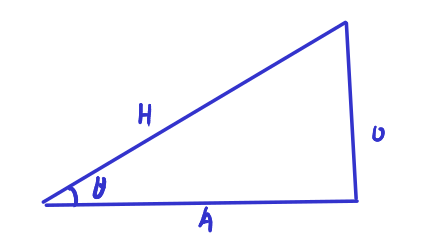
Suppose a triangle as such, \[\tan\theta=\frac{O}{A}\], \[\sin\theta=\frac{O}{H}\], \[\cos\theta=\frac{A}{H}\]. Combining all three equations, \[\tan\theta=\frac{H\sin\theta}{H\cos\theta}=\frac{\sin\theta}{\cos\theta}\].
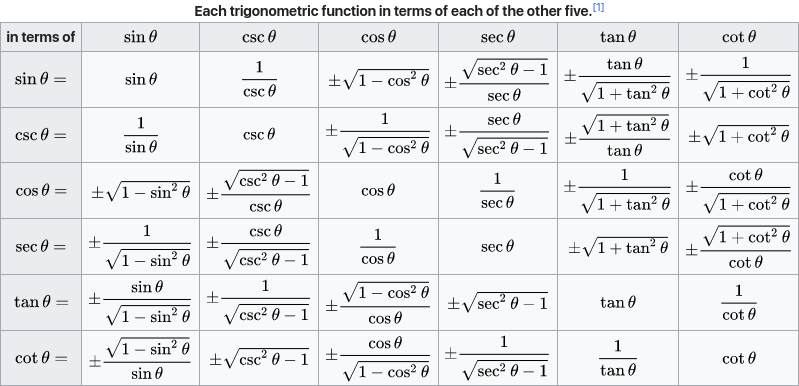
Relations between all six trigonomic functions
Reference angles
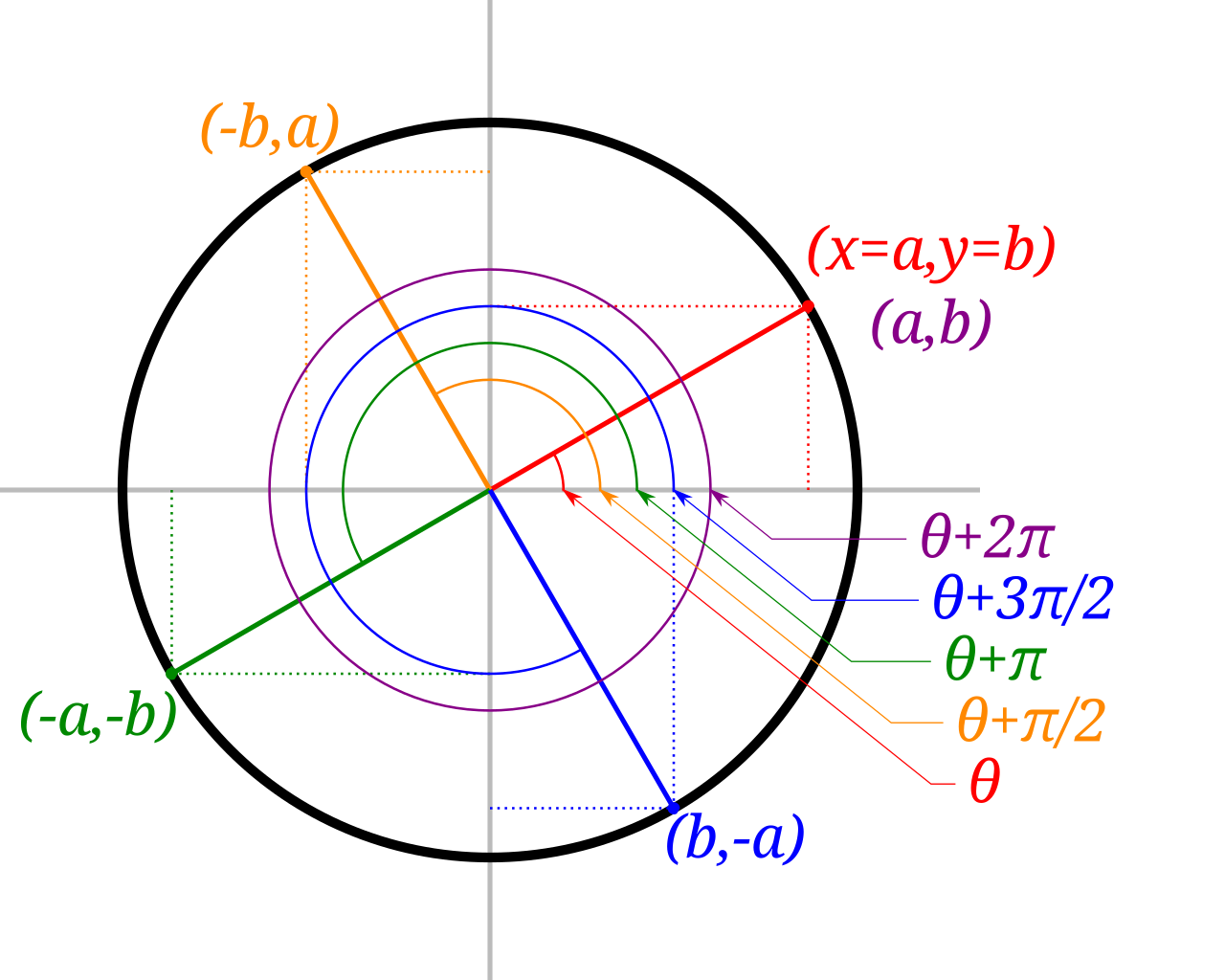
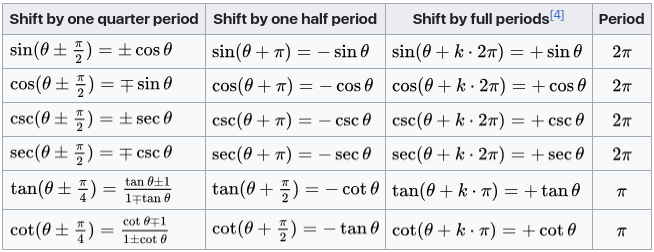
As an extension to reference angles, assume \[\theta=15^{\circ}\], we know that the angle \[90^{\circ}+15^{\circ}\] has a reference angle of \[75^{\circ}\]. Then, we say that \[\sin \left( 90^{\circ}+15^{\circ} \right)=\sin 75^{\circ}=\cos15^{\circ}\], or more generally \[\sin(90^{\circ}+\theta)=\cos\theta\]. Similarly, \[\cos (90^{\circ}+15^{\circ})=-(\cos75^{\circ})=-\sin15^{\circ}\], or more generally \[\cos(90^{\circ}+\theta)=-\sin\theta\] as it's in the second quadrant.
Or, we could deduce this relation judging entirely based on the coordinates, as \[(a,b)\] corresponds to \[(\cos\theta,\sin\theta)\], then when we shift it 90 degrees to a new point, i.e. to \[(-b,a)=(-\sin\theta,\cos\theta)\]. Since the new point represents the angle \[90^{\circ}+\theta\], we can deduce that \[-\sin(90^{\circ}+\theta)=\cos\theta\].
The full list: