partial pressure
Partial pressure
n a mixture of gases, each constituent gas has a partial pressure which is the notional pressure of that constituent gas as if it alone occupied the entire volume of the original mixture at the same temperature. The total pressure of an ideal gas mixture is the sum of the partial pressures of the gases in the mixture.
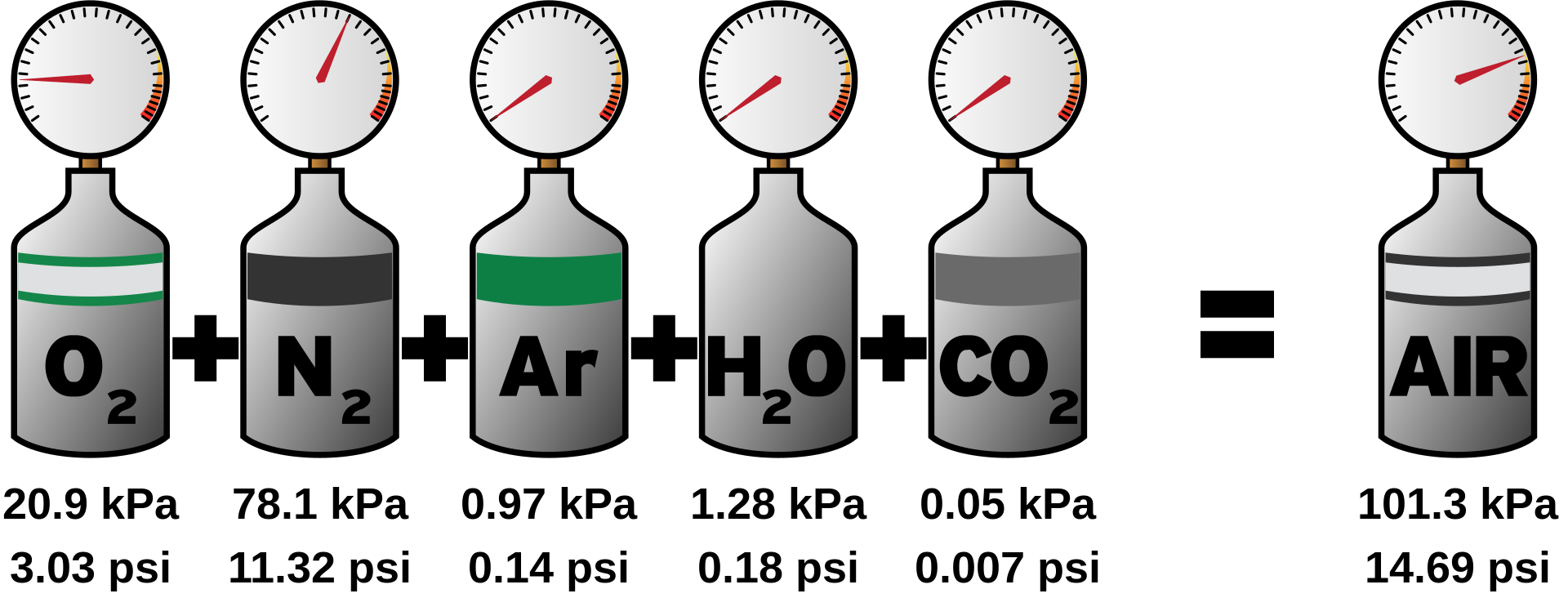
In the above example, the total pressure of the air, given as \[p\] would be \[p=p_{\ce{O2}}+p_{\ce{N2}}+p_{\ce{Ar}}+p_{\ce{H2O}}+p_{\ce{CO2}}\].
Mole fractions
The composition of a gas mixture can be described by the mole fractions of the gases present. The mole fraction, \[\chi\], of any component of a mixture is the ratio of the number of moles of that component to the total number of moles of all the species present in the mixture.
The mole fraction can be calculated via: \[\chi_{A}=\frac{\text{moles of }A}{\text{total moles}}=\frac{n_{A}}{n_{\text{total}}}\]. The mole fraction is a dimensionless quantity between 0 and 1. If \[\chi_{A}=1.0\], then the sample is pure \[A\], not a mixture. If \[\chi_{A}=0.0\], then no \[A\] is present in the mixture. The sum of the mole fractions of all the components present must equal 1.
Now to convert \[\chi\] to partial pressure, we can use the ideal gas law to describe the pressures: \[\frac{P_{A}}{P_{\text{total}}}=\frac{n_{A}\cdot \frac{RT}{V}}{n_{\text{total}}\cdot \frac{RT}{V}}=\chi_{A}\] ; \[\therefore P_{A}=\chi_{A}\cdot P_{\text{total}}\].
The mole fraction \[\chi_{A}\] represents the proportion of the total number of particles that are of gas \[A\]. The pressure in a gas is due to collisions of particles with the walls of the container, the contribution of each gas to the total pressure is proportional to the number of particles (moles) it contributes. Thus, the partial pressure of a gas in a mixture is just its proportional share of the total pressure, based on how many moles of it are present compared to the total moles in the mixture.