Markovnikov's rule
Markovnikov's rule
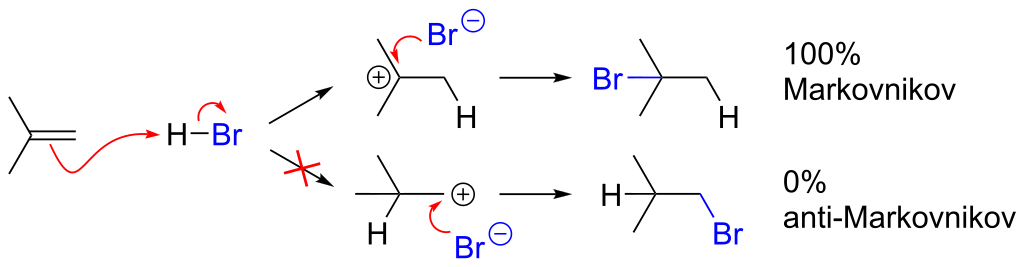
Markovnikov's rule describes the outcome of some addition reactions. The rule states that with the addition of a protic acid \[\ce{HX}\] or other polar reagent to an asymmetric alkene, the acid hydrogen (\[\ce{H}\]) or electropositive part gets attached to the carbon with more hydrogen substituents, and the halide (\[\ce{X}\]) group or electronegative part gets attached to the carbon with more alkyl substituents. In very simple terms, hydrogen wants to be with more hydrogens.
This is in contrast to Markovnikov's original definition, in which the rule states that the X component is added to the carbon with the fewest hydrogen atoms while the hydrogen atom is added to the carbon with the greatest number of hydrogen atoms.