derivative of natural exponential function
Derivative of the natural exponential function
Let function \[f(x)=b^{x}\]. Assume the value for \[f^{\prime}(0)=1\] exists for a unique value of \[b>0\].
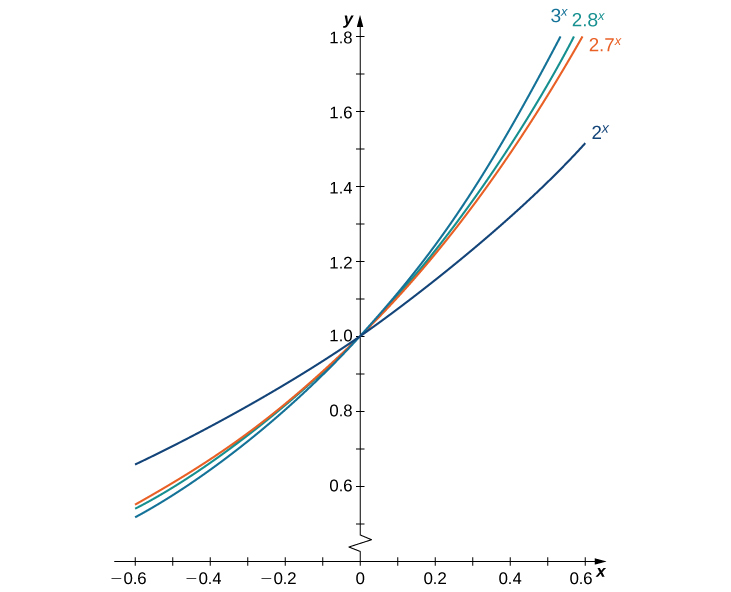
Assuming \[f^{\prime}(0)\] exists,
Now solving for \[f^{\prime}(x)\],
Do note that \[b^{x}\cdot f^{\prime}(0)\] does not apply for all \[b>0\] but is only valid for when \[b=e\].
Natural exponential
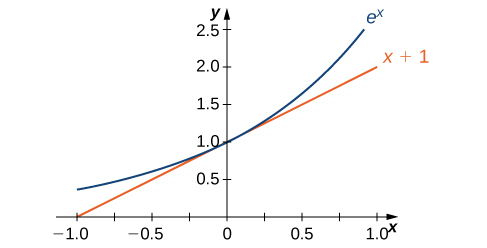
For \[f(x)=e^{x}\],
First we must solve for \[f^{\prime}(0)\] by using the Taylor series expansion for \[e^{x}\], where \[e^{x}=\sum_{n=0}^{\infty}\frac{x^{n}}{n!}=1+x+\frac{1}{2!}x^{2}+\frac{1}{3!}x^{3}+\frac{1}{4!}x^{4}+\cdots\],
Thus, \[f^{\prime}(0)=\lim_{h\to0}\frac{e^{h}-1}{h}=1\], proving that the value for \[f^{\prime}(0)=1\] exists for \[b>0\]. Combining our result with our formula above, \[f^{\prime}(x)=e^{x}\cdot f^{\prime}(0)=e^{x}\]. It is now proven that \[\left( e^{x} \right)^{\prime}=e^{x}\].
Since \[f(x)=f^{\prime}(x)=e^{x}\], using chain rule, we can generalise this formula. Let \[f(x)=e^{g(x)}, u=g(x)\],