pressure
Pressure
Pressure, \[p\], is the force applied perpendicular to the surface of an object per unit area over which that force is distributed, \[p=\frac{F}{A}\], and it's unit of measurement is \[\text{Pa}\] or \[\text{kgm}^{-1}\text{s}^{-2}\].
By measuring the force exerted per unit area, pressure gives us an idea of how intense the force application is. For example, a small force applied over a very small area (like a needle pressing into a surface) can result in high pressure, whereas the same force spread over a larger area results in lower pressure. This concept explains why sharp objects are more likely to pierce or cut—they concentrate force onto a smaller area, thereby increasing the pressure.
In gas
See ideal gas law.
In liquid
When a person swims under the water, water pressure is felt acting on the person's eardrums. The deeper that person swims, the greater the pressure. The pressure felt is due to the weight of the water above the person. As someone swims deeper, there is more water above the person and therefore greater pressure. Liquid pressure also depends on the density of the liquid. If someone was submerged in a liquid more dense than water, the pressure would be correspondingly greater. Thus, we can say that the depth, density and liquid pressure are directly proportionate.
The pressure due to a liquid in liquid columns of constant density or at a depth within a substance is represented by the following formula: \[p=\rho gh\], where \[g\] is the gravity at the surface, \[\rho\] is the density of said liquid, and \[h\] is height of liquid column or depth within a substance.
Derivation:
Difference in pressure between two different depths in a liquid: \[\Delta p=p_{2}-p_{1}=\rho g(h_{2}-h_{1})=\rho g\Delta h\].
Upthrust: When an object is immersed in liquid, the pressure at it's bottom is higher than the top of it, this is known as the buoyant force, \[F_{b}\]. Since \[F=pA\], \[F_{b}=h_{2}\rho gA-h_{1}\rho gA=(h_{2}-h_{1})\rho gA\]. Now since \[h_{2}-h_{1}\] is the height of the object, therefore \[F_{b}=\rho gAh=\rho gV\].
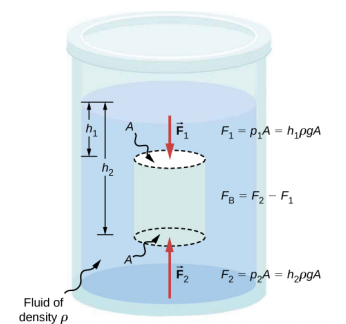
Archimedes' principle
Archimedes' principle that the upward buoyant force that is exerted on a body immersed in a fluid, whether fully or partially, is equal to the weight of the fluid that the body displaces. Therefore, \[F_{b}=W_{\text{fluid}}=\rho\cdot g\cdot V_{\text{displaced}}\].