structural isomerism
Structural isomerism
A structural isomer of a compound is a compound that contains the same number and type of atoms, but with a different connectivity (i.e. arrangement of bonds) between them.
Skeletal isomerism
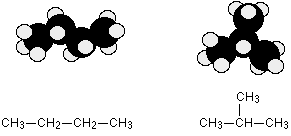
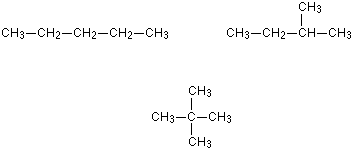
Known also as chain isomerism. These isomers arise because of the possibility of branching in carbon chains.
Butane (\[\ce{C4H10}\]):
Pentane (\[\ce{C5H12}\]):
Positional isomerism
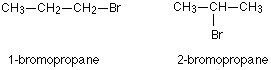
In position isomerism, the basic carbon skeleton remains unchanged, but important groups are moved around on that skeleton.
An example of such isomers is 1-bromopropane and 2-bromopropane.
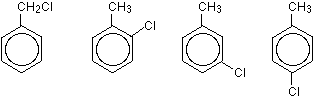
Benzene rings also do have positional isomers, e.g.
Functional isomerism
Functional isomers contain different functional groups, that is, they belong to different families of compounds.
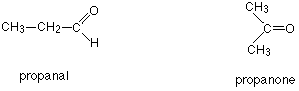
For instance, \[\ce{C3H6O}\] can either be a propanal (aldehyde) or a propanone (ketone).