projectile motion
Projectile motion
Projectile motion is a form of motion where an object moves in a bilaterally symmetrical, parabolic path. The path that the object follows is called its trajectory. Projectile motion only occurs when there is one force applied at the beginning on the trajectory, after which the only interference is from gravity.
Assume the parabolic path of a projectile is as such:
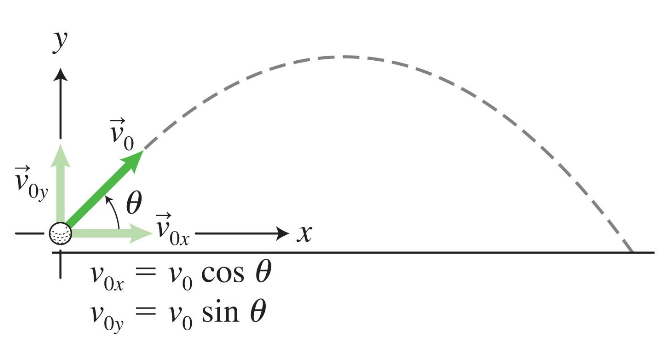
Note that we'll be using \[u\] instead of \[\vec{v}_{0}\].
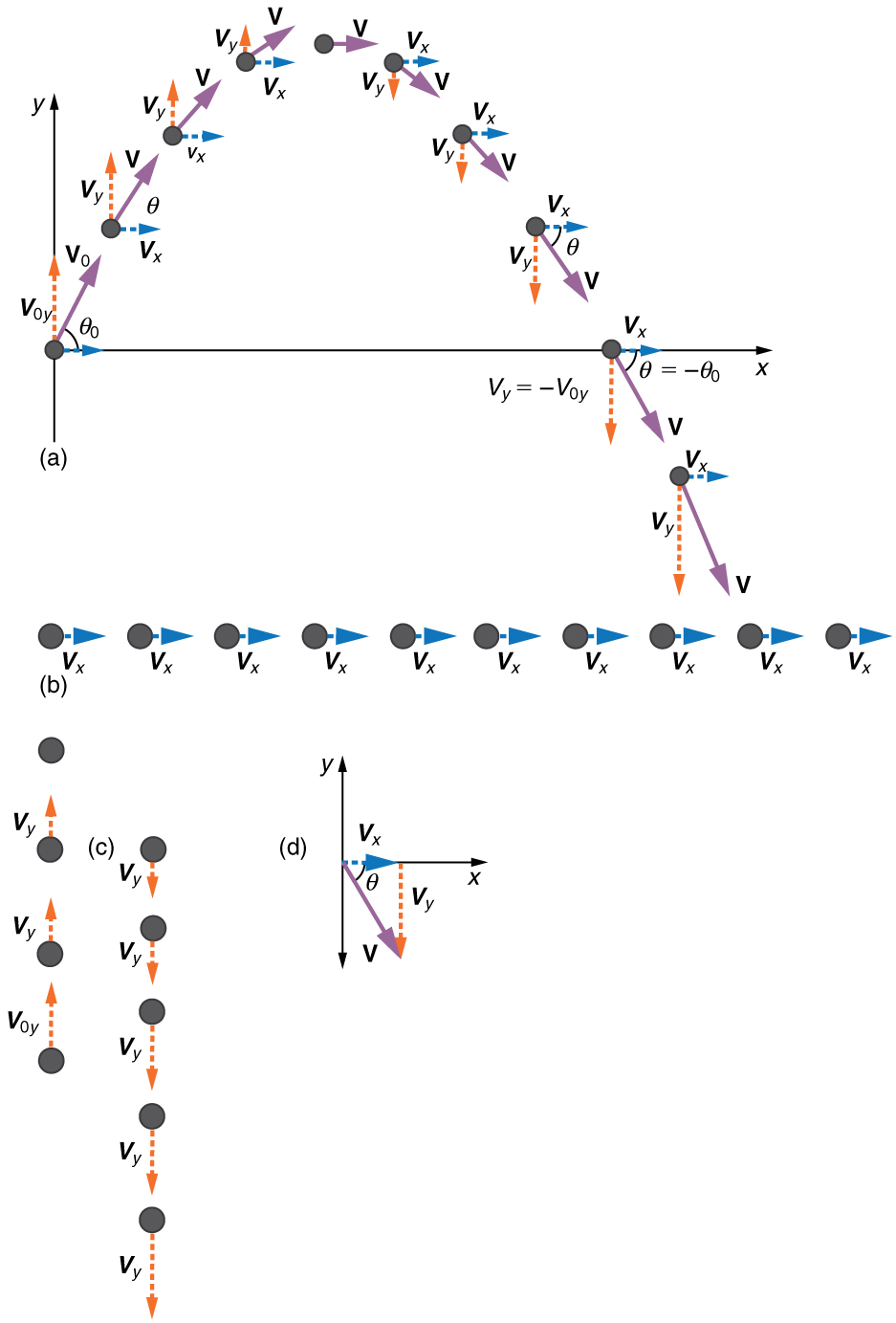
Acceleration
There is acceleration only in the vertical direction, the velocity in the horizontal direction is constant.
Velocity
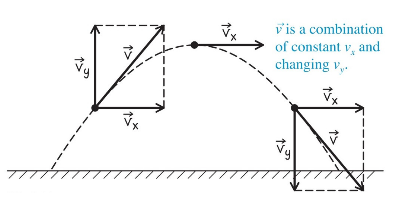
Using \[v=u+at\],
We get:
- \[v_{x}\]
The horizontal component of the velocity of the object remains unchanged throughout the motion, i.e. \[a=0\].
- \[v_{y}\]
The vertical component of the velocity changes linearly as the acceleration due to gravity is constant.
The magnitude of the velocity under the Pythagorean theorem is \[v=\sqrt{v_{x}^{2}+v_{y}^{2}}\].
Displacement
We can decompose the initial velocity, \[u\] into \[u_{x}=u\cos \theta\] and \[u_{y}=u\sin \theta\]. The equation for the horizontal, \[s_{x}\] and vertical displacement, \[s_{y}\] at time \[t\] is:
- \[s_{x}\]
- \[s_{y}\] and assuming \[a=-g\]
The magnitude of displacement is \[\Delta r=\sqrt{x^{2}+y^{2}}\].
Additional info for derivation of \[s_{y}\]
Assume \[a_{y}=-g\]
Range of projectile
We will first consider the range of a projectile on flat ground.
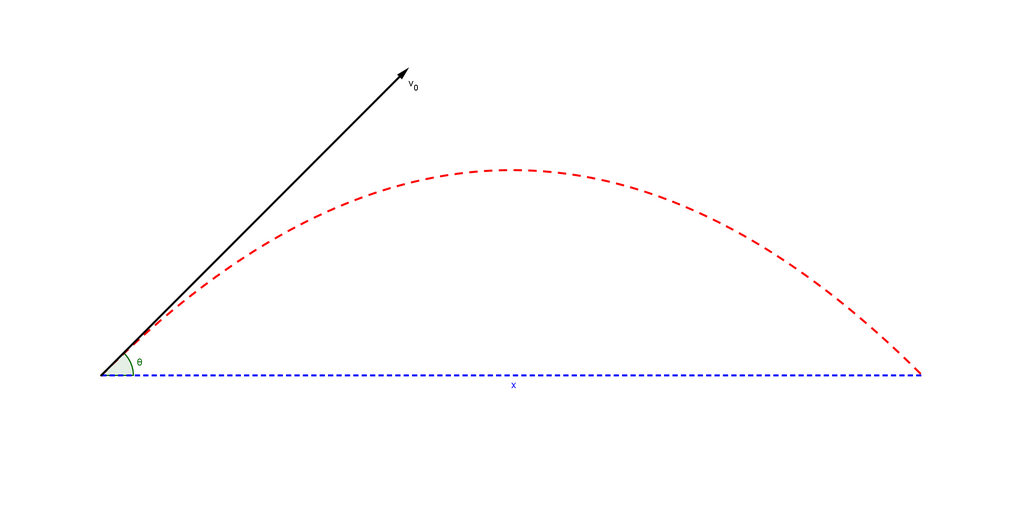
Let \[d\] be the range of the projectile. We know that \[s_{x}=ut\cos\theta\], \[s_{y}=ut\sin\theta-\frac{1}{2}gt^{2}\]. Since we're interested in the time when the projectile returns to the same height it originated, i.e. \[s_{y}=0\], thus \[0=ut\sin\theta-\frac{1}{2}gt^{2}\]. Factoring \[t\] out, \[0=u\sin\theta-\frac{1}{2}gt\implies t=\frac{2u\sin\theta}{g}\]. This is the formula for the time of flight of projectile.
Now, we substitute \[t=\frac{2u\sin\theta}{g}\] into \[s_{x}=ut\cos\theta\] to get \[d=\frac{2u^{2}\cos\theta\sin\theta}{g}\]. To get rid of the \[2\cos\theta\sin\theta\], we apply the double-angle identity \[2\cos\theta\sin\theta=\sin(2\theta)\] to get a final formula of \[d=\frac{u^{2}\sin(2\theta)}{g}\].
For uneven ground,
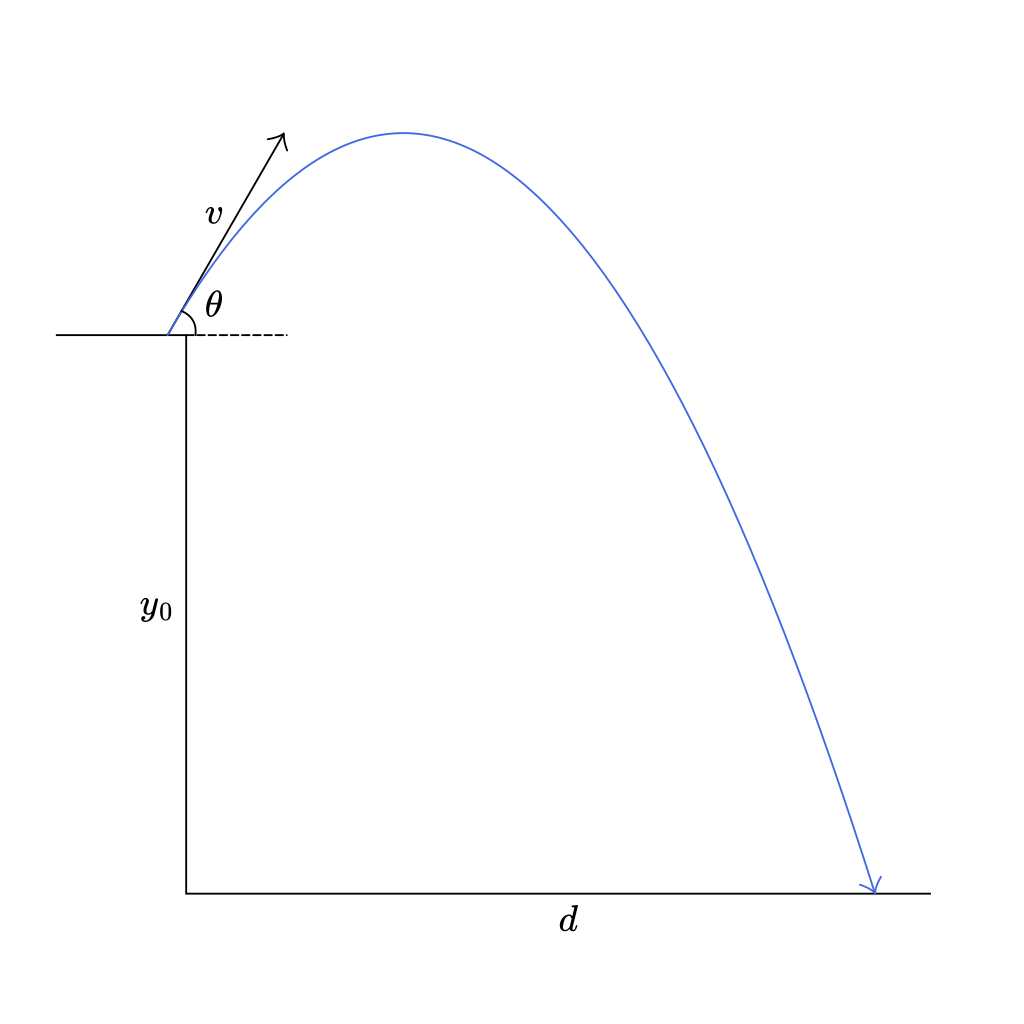
unlike our previous scenario, here we don't start at ground zero. Instead, we need to factor in the additional displacement in the \[y\]-direction \[s_{y}=y_{0}+ut\sin\theta-\frac{1}{2}gt^{2}\], i.e. when \[t=0\], \[s_{y}=y_{0}\]. Once again, we solve for when the projectile hits ground zero, i.e. \[0=y_{0}+ut\sin\theta-\frac{1}{2}gt^{2}\implies gt^{2}-2ut\sin\theta-2y_{0}=0\]. Applying the quadratic formula,
The square root must be a positive number, and since the velocity and the sine of the launch angle can also be assumed to be positive, the solution with the greater time will occur when the plus sign is used. Thus, the solution is \[t=\frac{u\sin\theta}{g}+\frac{\sqrt{u^{2}\sin^{2}\theta+2gy_{0}}}{g}\]. Substituting this back into \[s_{x}=ut\cos\theta\] we get \[d=\frac{u\cos\theta}{g}\left( u\sin\theta+\sqrt{u^{2}\sin^{2}\theta+2gy_{0}} \right)\].
Parabolic trajectory
If we restructure the equation using \[\tan\theta=\frac{\sin\theta}{\cos\theta}\],
where \[d\] is the range of the projectile on flat ground as derived above.
Since \[g\], \[\theta\] and \[u\] are constants, \[s_{y}=\tan\theta\cdot s_{x}-\frac{\tan\theta}{d}\cdot s_{x}^{2}\] is of the form \[y=ax+bx^{2}\] where \[a\] and \[b\] are constants. This is the equation of a parabola, showing that it's path is parabolic.
Maximum height of projectile
Since the increase of height will last until \[v_{y}=0\], we substitute that into \[v_{y}=u\sin\theta-gt\] to get \[u\sin\theta-gt_{h}=0\]. With our \[t_{h}\] we can then substitute that value into \[s_{y}=ut\sin\theta-\frac{1}{2}gt^{2}\] to get the maximum displacement in the \[y\]-direction (or the maximum height achievable by the projectile).