position and displacement vector
Position and displacement vector
The position of an object in space can be represented with a vector, often times with the symbol \[\vec{r}\], which describes the location of that object relative to some origin. We call this a position vector.
Notice that we say it's relative to some origin, as in physics we often use other coordinates (i.e. not the coordinate \[(0,0,0)\]) as the origin.
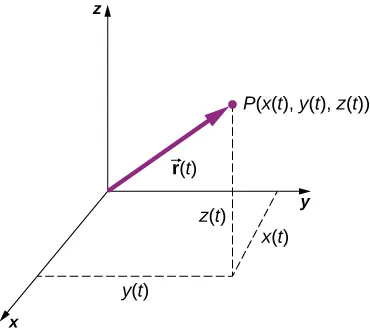
In Cartesian coordinates, a position vector is written using unit vectors, i.e. \[\vec{r}=x(t)\boldsymbol{\hat{\imath}}+y(t)\boldsymbol{\hat{\jmath}}+z(t)\boldsymbol{\hat{k}}\]. \[x\], \[y\] and \[z\] are written here as a function of time as usually we're concerned about the position of an object at some point in time, however we can replace it with any other symbol (that is suitable/relevant), e.g. \[r_{x}\], \[r_{y}\] or \[r_{z}\].
Displacement vector
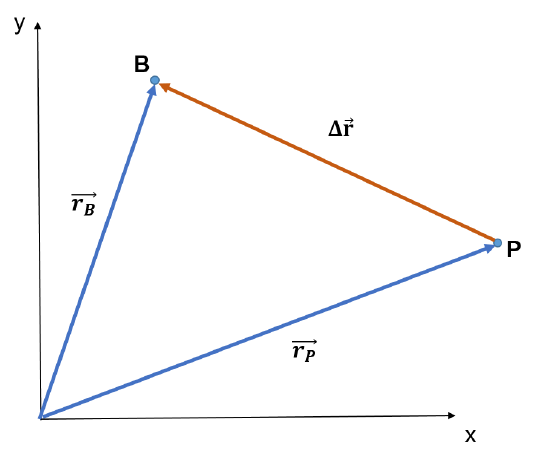
A displacement vector describes the change in an object's position, i.e. \[\Delta \vec{r}=\vec{r}_{f}-\vec{r}_{i}\]. If the displacement is infinitesimal, it is written as \[d\vec{r}\] instead of \[\Delta \vec{r}\]. In simple words, it's just a vector that points form one point to another, but the difference is that it can start anywhere.
With the displacement vector, finding how far is one point from the other, is as simple as finding the magnitude of the displacement vector.