polynomials
Polynomials
Notes regarding different types of polynomials
Root substitution
We're given a cubic function \[x^{3}+x^{2}-7=0\] with roots \[\alpha\], \[\beta\] and \[\gamma\]. To find a cubic function with roots of \[\frac{1}{\alpha}\], \[\frac{1}{\beta}\] and \[\frac{1}{\gamma}\], first we assume \[y\] as one of the roots of the new cubic function and \[x\] as the roots of the original cubic function. Therefore, according to the relation, \[y=\frac{1}{x}\] and \[x=\frac{1}{y}\].
Substituing the value of \[x\] we get \[\left(\frac{1}{y}\right)^{3}+\left(\frac{1}{y}\right)^{2}-7=0\] which simplifies to \[7y^{3}-y-1=0\]
Recurrence notation
Given a polynomial \[ax^{3}+bx^{2}+cx+d=0\], with roots \[\alpha\], \[\beta\], \[\gamma\], the recurrence notation would be \[S_{n}=\alpha^{n}+\beta^{n}+\gamma^{n}\].
The relation between this \[S_{n}\] and the equation above would be that \[ax^{3}+bx^{2}+cx+d=0\] can be turned into \[aS_{3}+bS_{2}+cS_{1}+dS_{0}=0\]. Note: \[x^{n}\ne S_{n}\]
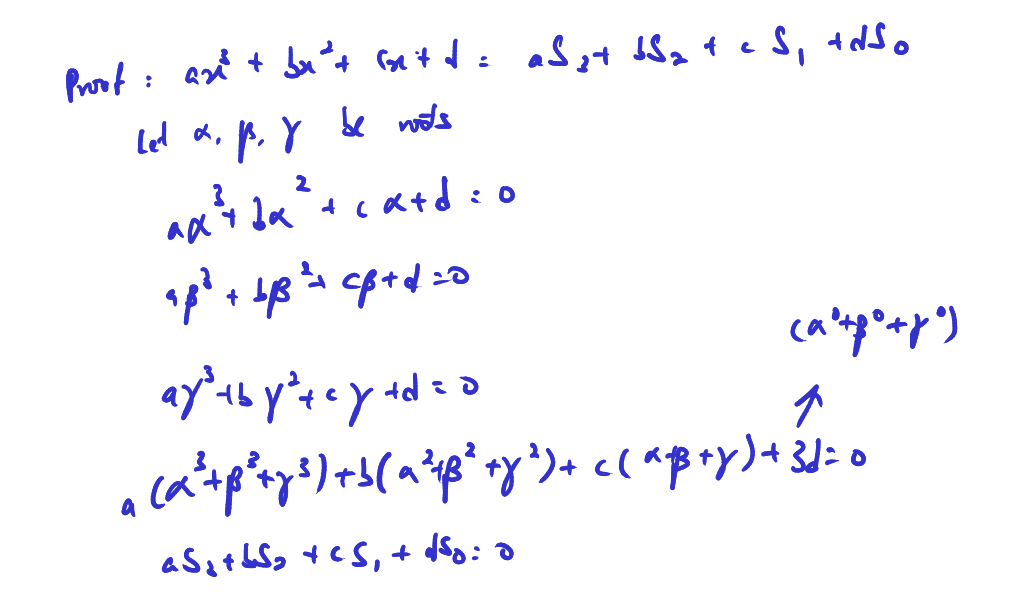
In fact, \[ax^{3}+bx^{2}+cx+d=0\] can turn into \[aS_{n+3}+bS_{n+2}+cS_{n+1}+dS_{n}=0\] where \[n\in\mathbb{R}\].