Cubic equations are in the form of \[ax^{3}+bx^{2}+cx+d=0\] or
\begin{equation}
\tag{1}
x^{3}+\frac{b}{a}x^{2}+\frac{c}{a}x+\frac{d}{a}=0
\end{equation}
Let the roots of the equation above be \[\alpha\], \[\beta\] and \[\gamma\].
\begin{align*}
(x-\alpha)(x-\beta)(x-\gamma)=0 \\
\tag{2}
x^{3}-(\alpha+\beta+\gamma)x^{2}+(\alpha\beta+\alpha\gamma+\beta\gamma)x-\alpha\beta\gamma=0
\end{align*}
By comparing (1) and (2) we get that:
\begin{align*}
\alpha+\beta+\gamma&=-\frac{b}{a}=\Sigma\alpha=S_{1} \\
\alpha\beta+\alpha\gamma+\beta\gamma&=\frac{c}{a}=\Sigma\alpha\beta \\
\alpha\beta\gamma&=-\frac{d}{a}=\Sigma\alpha\beta\gamma
\end{align*}
Note: There's a difference between \[\Sigma\alpha^{2}\] and \[(\Sigma\alpha)^{2}\]. \[\Sigma\alpha^{2}=\alpha^{2}+\beta^{2}+\gamma^{2}\] while \[(\Sigma\alpha)^{2}=(\alpha+\beta+\gamma)^{2}\].
A useful trick for solving cubic-related problems is that:
\begin{align*}
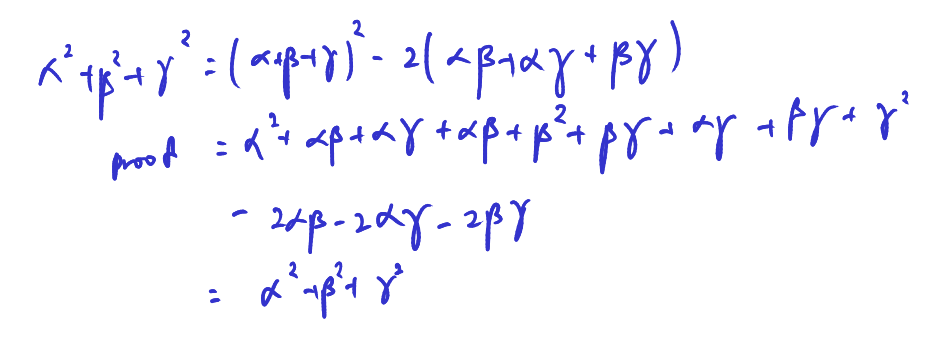
(\alpha+\beta+\gamma)^{2}=(\alpha^{2}+\beta^{2}+\gamma^{2})+2(\alpha\beta+\alpha\gamma+\beta\gamma)
\end{align*}
A somewhat related proof for the above equation:
Another useful trick would be that:
\begin{align*}
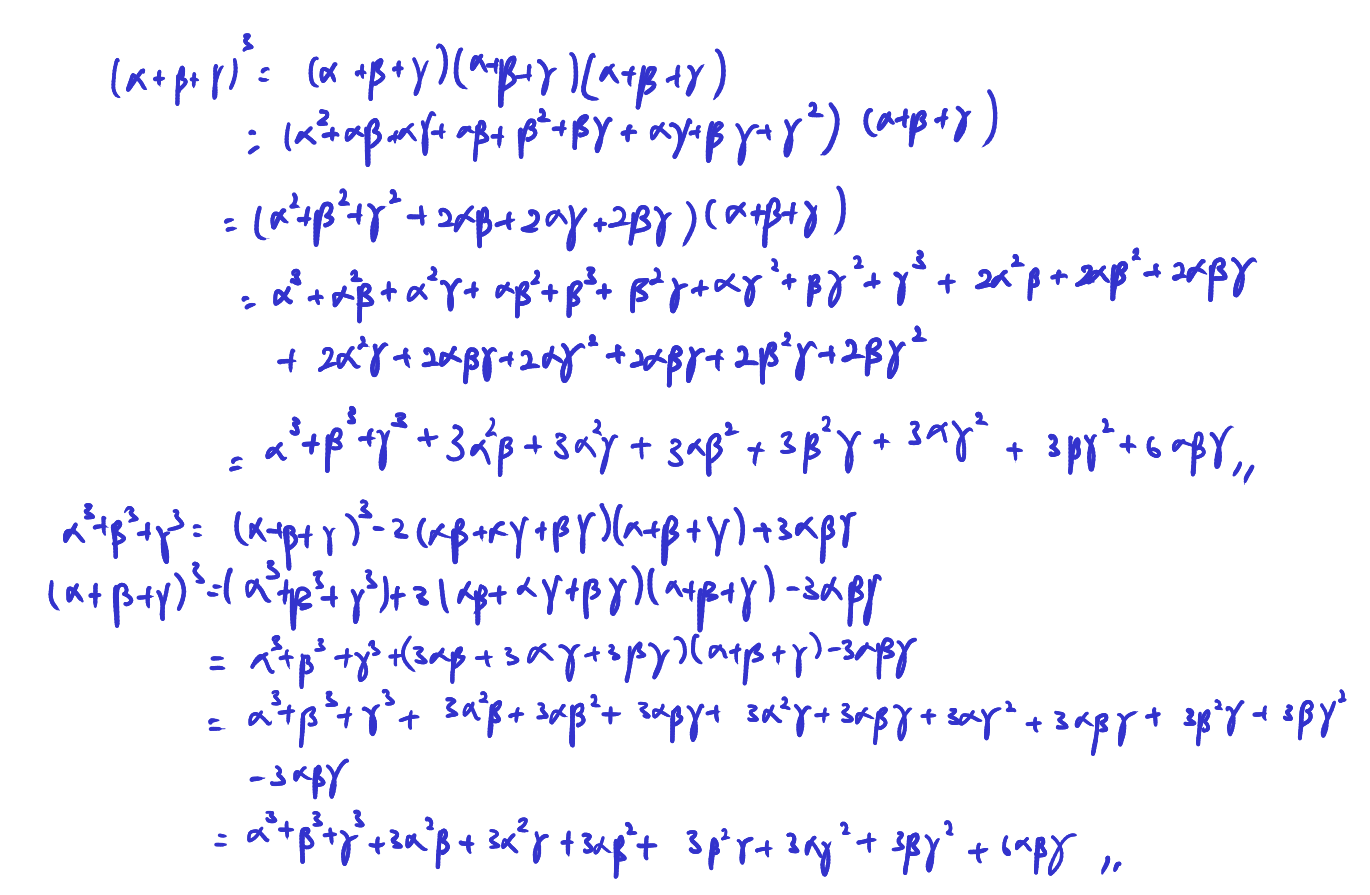
S_{3}=\alpha^{3}+\beta^{3}+\gamma^{3}=(\alpha+\beta+\gamma)^{3}-3(\alpha\beta+\alpha\gamma+\beta\gamma)(\alpha+\beta+\gamma)+3\alpha\beta\gamma
\end{align*}
Proof: