Malus's law
Malus's law
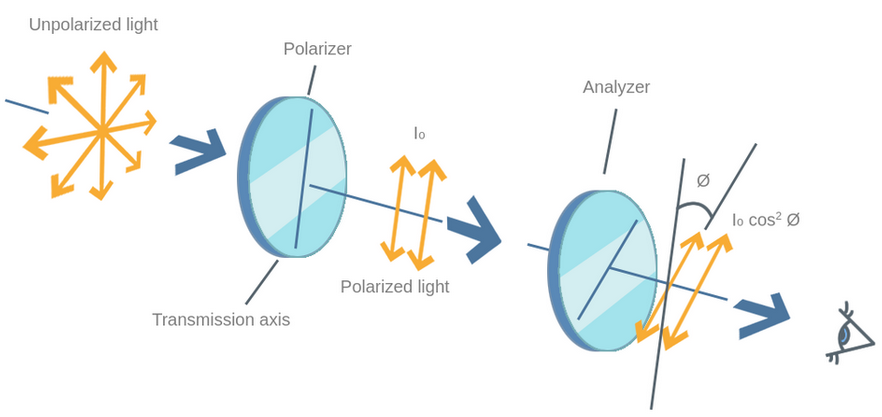
Malus's law states that when a perfect polarizer is place din a polarized beam of light, the irradiance (or intensity), \[I\], of the light that passes through is given by \[I=I_{0}\cos^{2}\theta\], where \[\theta\] is the angle between the light's initial polarization direction and the axis of the polarizer.
Derivation
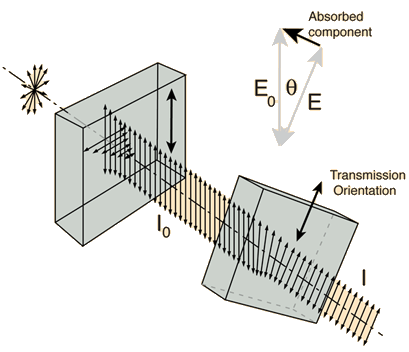
Assume the amplitude of the initial polarized wave is \[E\]. When a second polarizer is rotated, the vector component perpendicular to its transmission plane is absorbed, reducing its amplitude to \[E=E_{0}\cos\theta\]. Since irradiance is proportional to the amplitude squared, i.e. \[I\propto E^{2}\], \[I=I_{0}\cos^{2}\theta\].