linear equation
Linear equation
A linear equation in two variables \[x\] and \[y\] can be written as \[ax+by+c=0\] where \[a\] and \[b\] are not both 0.
Linear equations should not be confused with linear functions. A linear function is a function which fulfills the properties \[f(a+b)=f(a)+f(b)\] and \[f(a\cdot x)=a\cdot f(x)\], while linear equations do not fulfill these properties.
Proof
In Euclidean geometry, take two perpendicular lines though a point \[O\], call one of of them the \[x\]-axis and the other than \[y\]-axis. Drawing lines parallel to the axes gives the coordinate functions \[x(P)\] and \[y(P)\] on points \[P\] of the plane.
The statement that \[ax(P)+by(P)\] is constant for points \[P\] that lies on a line \[L\] can also be thought of as the oriented area of the triangle cut off by \[L\] and the coordinate axes. Therefore, it can be decomposed as the sum of areas of the subtriangles \[\triangle OPA+\triangle OBP=\triangle OBA\], when multiplied by 2 gives us \[ax(P)+by(P)=2\cdot\triangle OBA\]. We can then let constant \[c=-2\cdot \Delta OBA\] to get \[ax(P)+by(P)+c=0\].
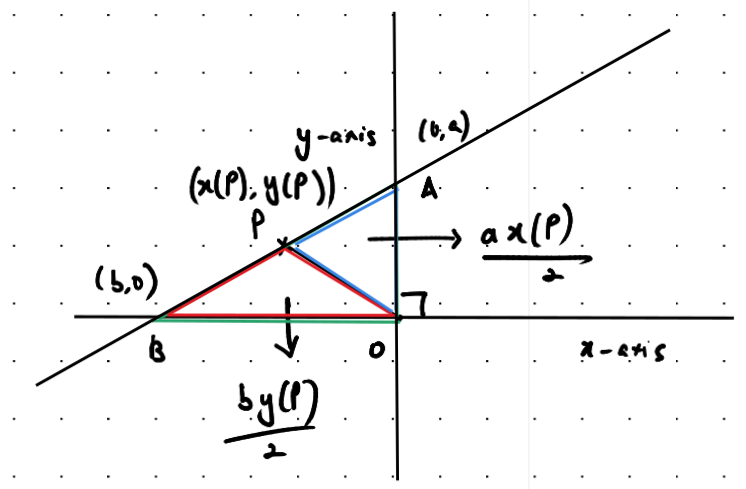
The term oriented plays a role when \[P\] does not lie in between the segment \[AB\].
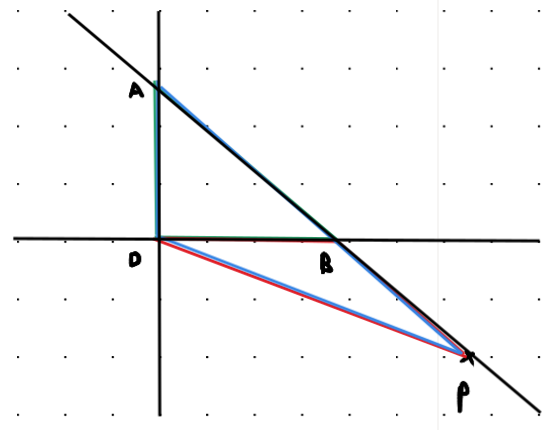
As you can see, if we don't take the oriented areas logically \[\triangle OBA\ne\triangle OPA+\triangle OBP\]. However, if we take points that are listed clockwise, e.g. \[\Delta OBP\implies O\to B\to P\] as positive area and points that are listed anticlockwise, e.g. \[\triangle OBA\implies O\to B\to A\] as negative area, then \[\triangle OBA=\triangle OPA+\triangle OBP\]. To demonstrate it more explicitly, the equation above is equivalent to \[-\left| \Delta OBA \right|=-\left| \triangle OPA \right|+\triangle OBP\].
To prove the statement above, we will be calculating the area by coordinates.
The general proof for the formula to calculate area of triangle by coordinates is shown below.
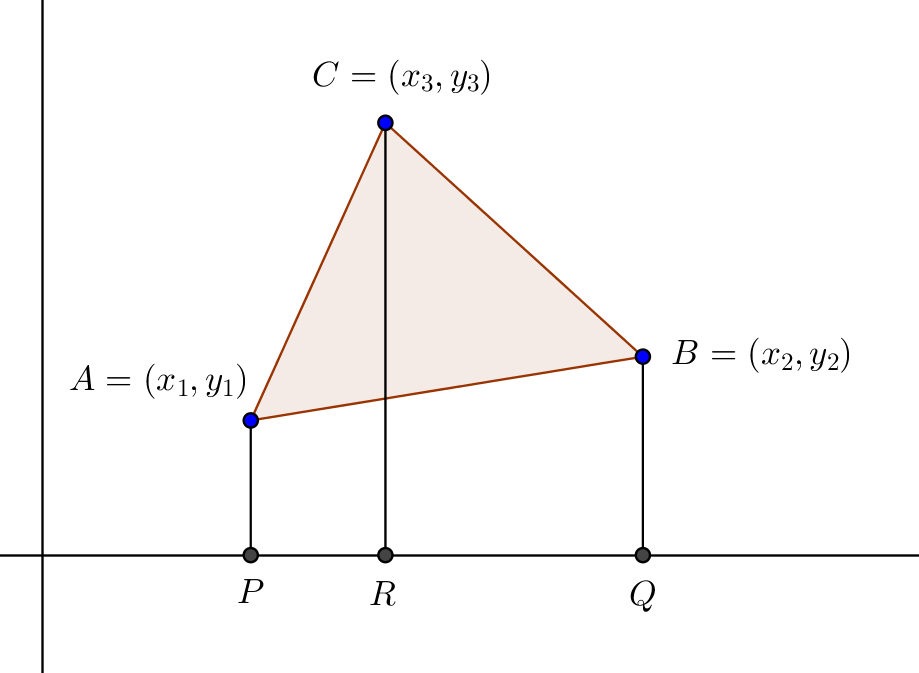
From the figure, we can see that the area of \[ABC\] is the equivalent to the area of \[PACR+RCBQ-PABQ\]. Then, using the formula for the area of trapezium, \[\frac{h(a+b)}{2}\] where \[h\] is the height and \[a,b\] are the parallel sides,
If we look closely, this looks very similar to the determinant of the matrix \[\begin{pmatrix} x_{1}&x_{2}&x_{3}\\y_{1}&y_{2}&y_{3}\\1&1&1 \end{pmatrix}\].
Technically the final formula would be \[T=\frac{1}{2}\left| \det \begin{pmatrix} x_{1}&x_{2}&x_{3}\\y_{1}&y_{2}&y_{3}\\1&1&1 \end{pmatrix} \right|\], however since we do care about the orientation we will not be including the absolute brackets.
Therefore, the calculation for \[\Delta OBA\] would now become,
Then, \[2\cdot \Delta OBA=ax+by\]. Similar to what we've done above, let constant \[c=-2\cdot \Delta OBA\], then \[ax+by+c=0\].