double-slit experiment
Double-slit experiment
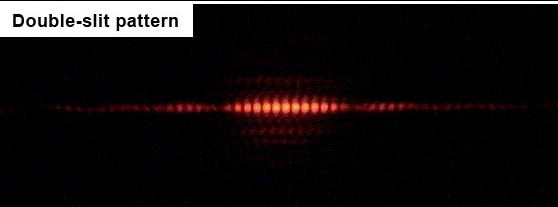
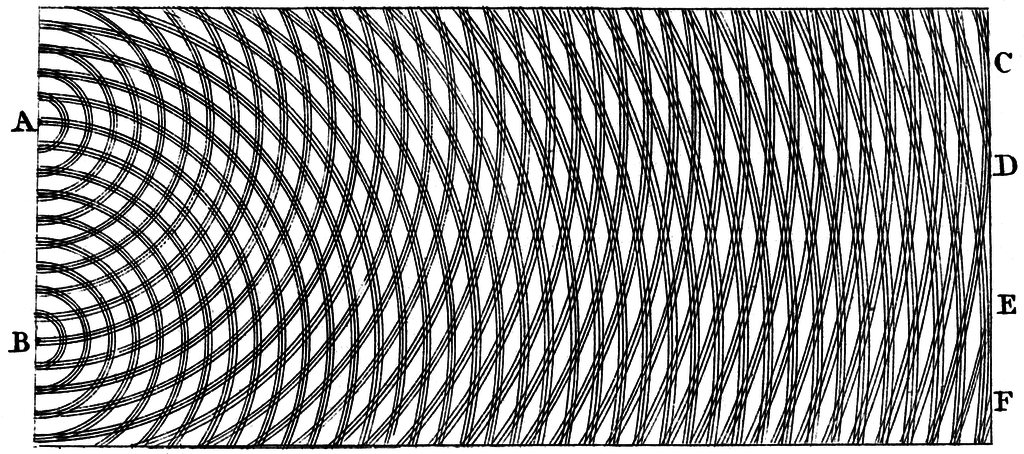
The double-slit experiment is an experiment that demonstrates light and matter can exhibit behaviour of both classical particles and classical waves.
Two-slit diffraction pattern
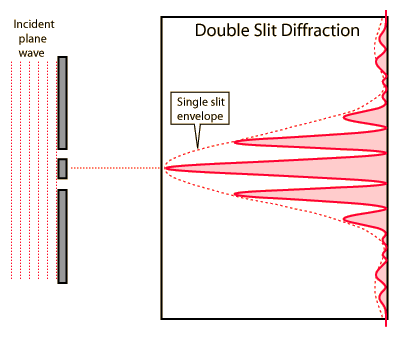
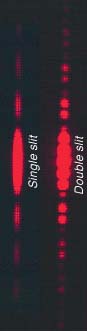
If we were to draw the waves out:
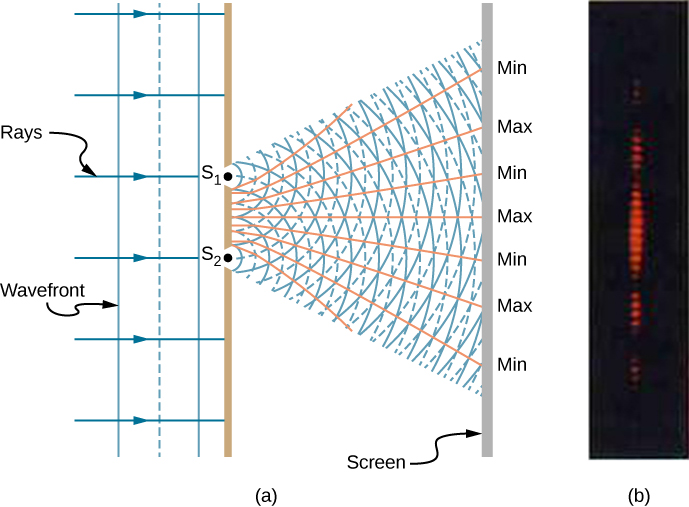
Path length difference
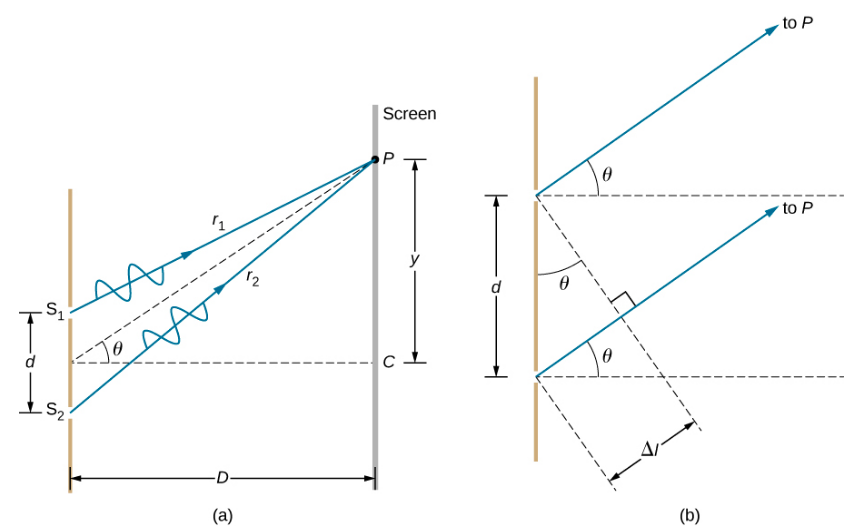
The figure above illustrates how one should determine the path length difference for waves travelling from two slits to a common point on a screen. If the screen is a large distance away compared with the distance between the slits, then \[r_{1}\] and \[r_{2}\] are essentially parallel (but with different lengths), which makes calculation much easier.
Assuming \[r_{1}\] and \[r_{2}\] are parallel, the path length difference, \[\Delta l\], can calculated with simple trigonometry, i.e. \[\sin\theta=\frac{\Delta l}{d}\implies d\sin\theta=\Delta l\], where \[d\] is the distance between the slits.
Now, if the point on the screen is a bright fringe, these two waves must be interfering constructively, i.e. both arriving at point P at its crest. Since they have the same wavelength and are coherent, \[\Delta l\] must be some multiple of their wavelength. We can express this as \[\Delta l=m\lambda\].
Similarly, if it is a dark fringe, these two waves must be interfering destructively, which implies they are out of phase, i.e. one arriving as crest, another as trough. Then, \[\Delta l\] must be some multiple + \[\frac{1}{2}\] of their wavelengths. We express this as \[\Delta l=\left( m+\frac{1}{2} \right)\lambda\].
Then, combine this with our previous equation, we can finalise our equation. Let \[m\] be the order of interference, \[m=0,\pm1,\pm2,\pm3,\dots\], then \[d\sin\theta=m\lambda\] when the waves constructively interfere (bright fringe) and \[d\sin\theta=\left( m+\frac{1}{2} \right)\lambda\] when the waves destructively interfere (dark fringe).
Distance between bright/dark fringes
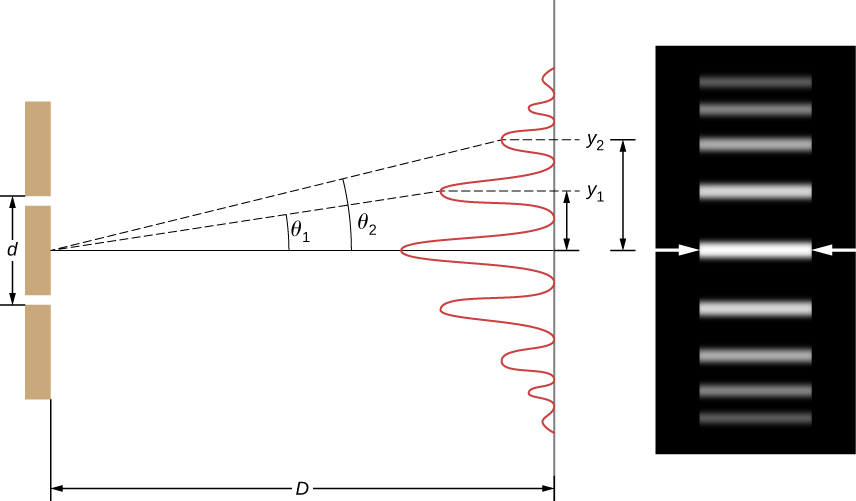
Now, assuming the screen is distant enough such that \[D\] is approximately equal to distance travelled by the wave, we can approximate \[\sin\theta_{1}\approx\frac{y_{1}}{D}\], same goes for \[\theta_{2}\], where \[\sin\theta_{2}\approx \frac{y_{2}}{D}\]. With this approximation, we can substitute this into our \[d\sin\theta=m\lambda\] equation to get \[d \frac{y_{m}}{D}=m\lambda\] or \[y_{m}=\frac{m\lambda D}{d}\]. Now this may seem very strange.
However, if we were to substitute \[m=1\], assuming we're only interested in the distance between each fringe, \[y=\frac{\lambda D}{d}\implies \lambda=\frac{yd}{D}\]. If we switch \[y\] for \[a\] (distance between each fringe) and \[d\] for \[x\] (distance between the two coherent sources), our equation would become the familiar \[\lambda=\frac{ax}{D}\].