center of mass of solids
Center of mass of solids
Cone
The general formula to find the distance from origin to center if mass is \[\frac{3}{4}h\]. NOTE: This formula finds the distance between the center of mass and the apex of the cone.
The idea behind the formula is to slice the cone into infinitely thin slices of height \[dx\].
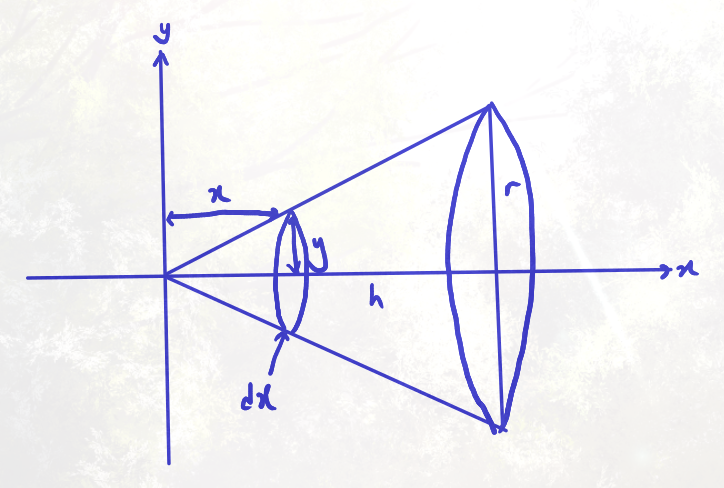
- Mass of cone: \[\frac{1}{3}\pi r^{2}h\rho\]
- Mass of small slice of height \[dx\]: \[\pi r^{2}h\rho=\pi y^{2}\rho dx\], reasoning being the small slice of the cone is infinitely thin, therefore it can be assumed to be a cylinder
- Here since it lies in the middle of the \[x\]-axis, \[\overline{y}\] is zero, therefore \[\overline{x}\] is be the distance between the center of mass and point of origin, but this will not be the case if \[\overline{y}\] is not zero
- Moment of any given small slice \[dx\]: Mass * distance = \[\pi y^{2}\rho dx\cdot x=\pi xy^{2}\rho dx\]
- \[y=\frac{r}{h}x\]
Since we know \[\overline{x}=\frac{M_{y}}{m}\],
Hemisphere
The general formula to find the distance between the center of mass and origin (flat plate) is \[\frac{3}{8}r\]
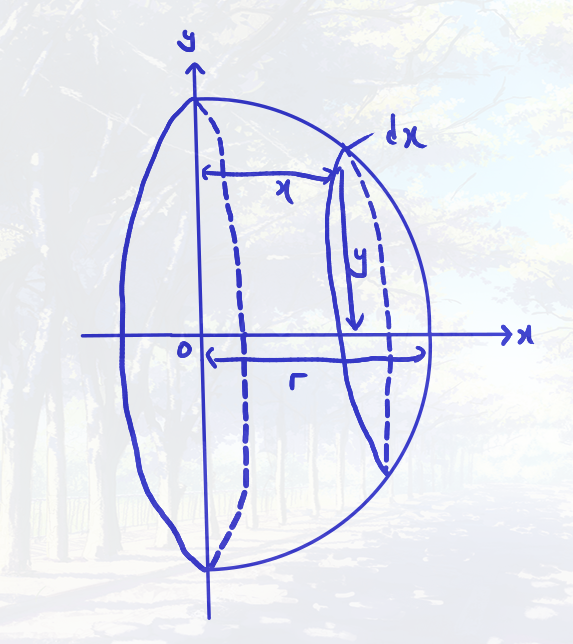
- Mass of each slice \[dx\]: \[\pi y^{2}\rho dx\] (reasons the formula is stated in the proof for cones)
- Equation for circle: \[x^{2}+y^{2}=r^{2}\]
- Mass of hemisphere: \[\frac{2}{3}\pi r^{3}\rho\]
- Here since it lies in the middle of the \[x\]-axis, \[\overline{y}\] is zero, therefore \[\overline{x}\] is be the distance between the center of mass and point of origin, but this will not be the case if \[\overline{y}\] is not zero