inverse trigonometry functions
Inverse trigonometry functions
It is to note that \[\frac{1}{\tan \theta}\ne\tan^{-1}\theta\], as \[\tan^{-1}\theta\] is actually the inverse function of \[\tan\theta\]. Same applies for the other trigonometric functions. To prevent confusion, one could write \[\arctan \theta\] instead of \[\tan^{-1}\theta\].
\[\sin^{-1}\]
A usual sine graph looks like this:
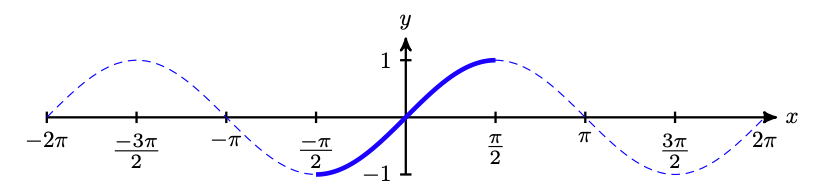
However, now that we inverse the function, it becomes like this (notice how essentially the axises are flipped):
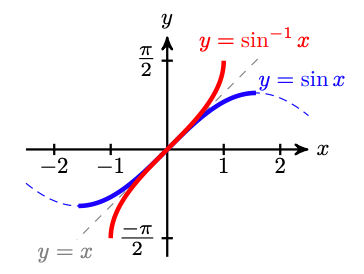
This is due to the fact that if the red line extends any further, each \[x\] value would have multiple \[y\], which violates the rules of a function.
Hence, the definition of function \[f(x)=\sin^{-1}x\] is \[\sin^{-1}x=\theta\] if \[\sin\theta=x\] and \[-\frac{\pi}{2}\le\theta\le \frac{\pi}{2}\].
\[\cos^{-1}\]
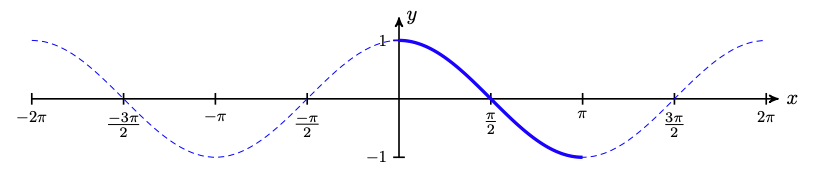
Graph of \[\cos x\]:
Graph of \[\cos^{-1}x\]:
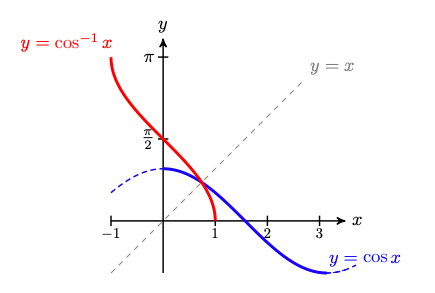
The definition of function \[f(x)=\cos^{-1}x\] is \[\cos^{-1}x=\theta\] if \[\cos\theta=x\] and \[0\le\theta\le\pi\].
\[\tan^{-1}\]
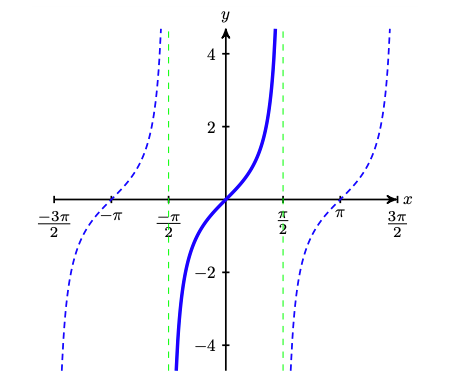
Graph of \[\tan x\]:
Graph of \[\tan^{-1}x\]
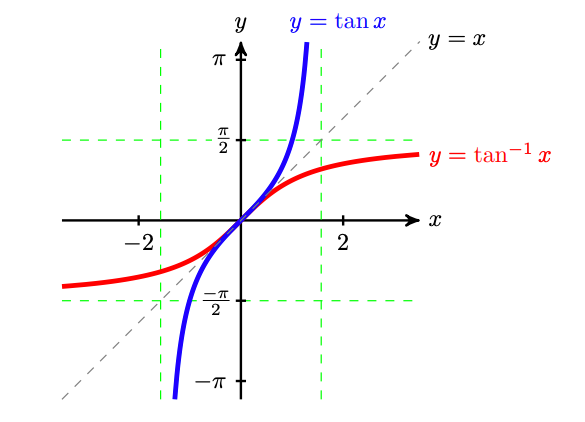
The function \[f(x)=\tan^{-1}x\] is defined as \[\tan^{-1}x=\theta\] if \[\tan\theta=x\] and \[-\frac{\pi}{2}<\theta<\frac{\pi}{2}\].
\[\csc^{-1}\]
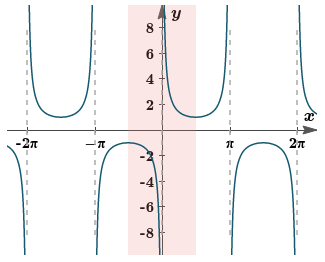
Graph of \[\csc x\]:
Graph of \[\csc^{-1}x\]:
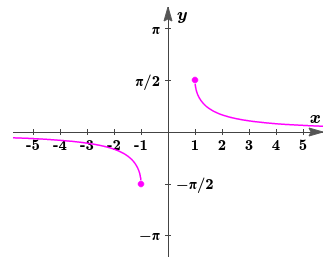
The function \[f(x)=\csc^{-1}x\] is defined as \[\csc^{-1}x=\theta\] if \[\csc \theta=x\] and \[-\frac{\pi}{2}\le\theta\le \frac{\pi}{2},\theta\ne0\].
\[\sec^{-1}\]
Graph of \[\sec x\]:
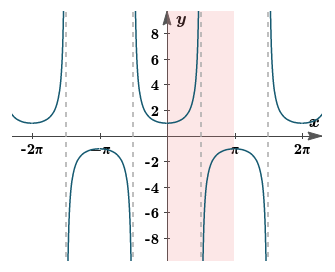
Graph of \[\sec^{-1}x\]:
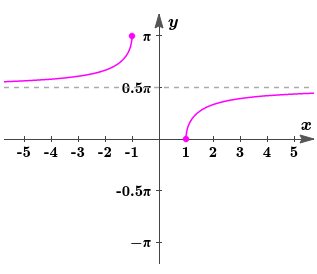
The function \[f(x)=\sec^{-1}x\] is defined as \[\sec^{-1}x=\theta\] if \[\sec\theta=x\] and \[0\le\theta\le\pi,\theta\ne \frac{\pi}{2}\].
\[\cot^{-1}\]
Graph of \[\cot x\]:
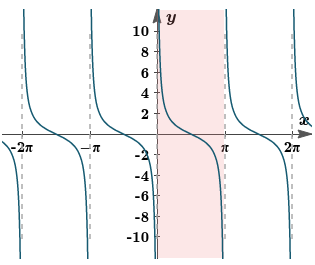
Graph of \[\cot^{-1}x\]:
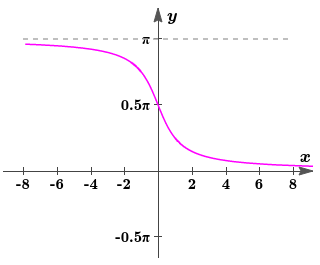
The function \[f(x)=\cot^{-1}x\] is defined as \[\cot^{-1}x=\theta\] if \[\cot\theta=x\] and \[0<\theta<\pi\].