inverse-square law
Inverse-square law
An inverse-square law is any scientific law stating that the observed "intensity" of a specified physical quantity is inversely proportional to the square of the distance from the source of that physical quantity.
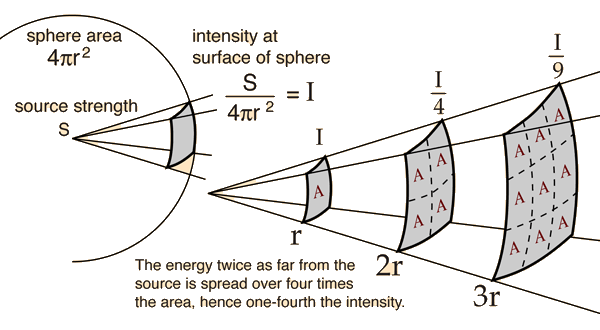
It is said that any point source that spreads its influence equally in all directions without a limit to its range obeys the inverse square law. This comes from strictly geometrical considerations. The surface area of a sphere (i.e. \[4\pi r^{2}\]) is proportional to the square of the radius, as the emitted force/energy/etc. gets farther from the source, it is spread out over an area that is increase in proportion to the square of the distance from the source.
A way to look at the inverse-square law is that it just is. It holds only when the object emits the force uniform in all directions from one point. In fact, gravity and electricity do not follow the inverse-square law in general. When we start factoring in magnetic interactions as well as the shape of charge distributions, the law no longer holds.
Referenced by:
No backlinks found.