elementary row operations
Elementary row operations
There are only three types of elementary row operations:
Row switching
A row within a matrix can be switched with another row.
\[R_{i} \leftrightarrow R_{j}\]
Row multiplication
Each element in a row can be multiplied with a nonzero constant.
\[kR_{i} \rightarrow R_{i}, k\ne 0\]
Row addition
A row can be replaced by the sum of that row and a multiple of another row.
\[R_{i}+kR_{j}\rightarrow R_{i},i\ne j\]
Proof
We imagine the matrix as a system of equations, and each row as an equation. The row operations only change the system of equations, now the set of solutions to the equations.
Assume \[-x+2y=2,x-y=0\]. When we add the first equation to the second, \[-x+2y=2,y=2\], the graphs will be altered but not the solution as demonstrated below.
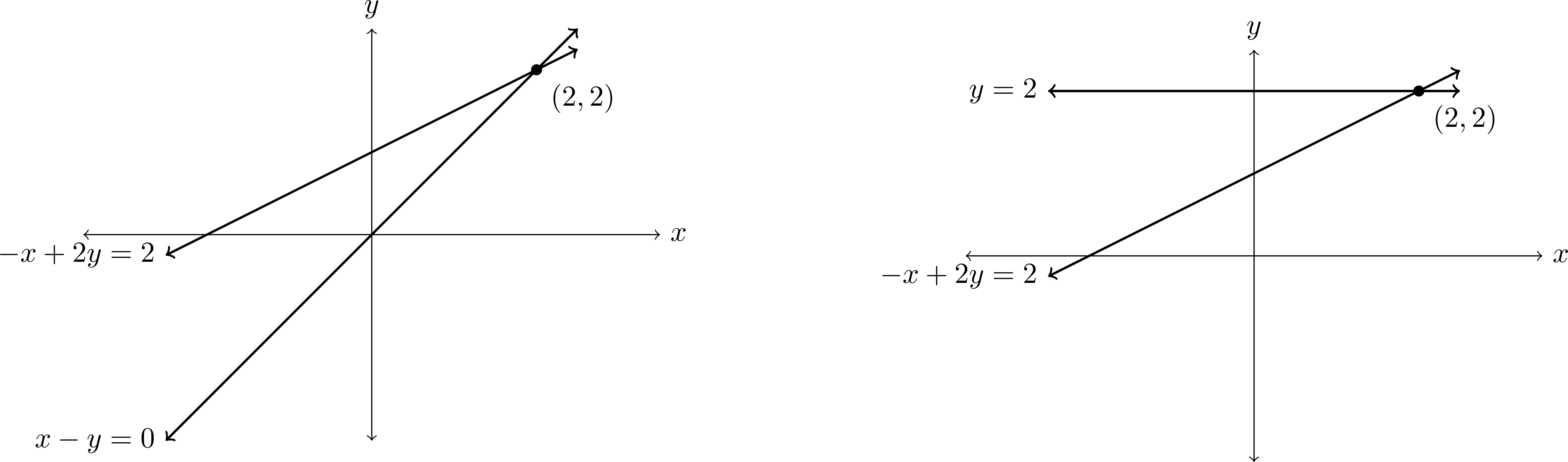
This is because if \[x\] satisfy the equations \[E_{1}\] and \[E_{2}\], then it will satisfy the equations \[E_{1}\] and \[E_{1}+E_{2}\]. Conversely, if \[x\] satisfies the equation \[E_{1}\] and \[E_{1}+E_{2}\] then it satisfies the equations \[E_{1}\] and \[(E_{1}+E_{2})-E_{1}=E_{2}\]. Thus we conclude that \[x\] satisfies \[E_{1}\] and \[E_{2}\] if and only if \[x\] satisfies \[E_{1}\] and \[E_{1}+E_{2}\].